
Nanoscale photonic artificial neuron with biological signal processing
An experimentally demonstrated nanowire neuron combines excitatory and inhibitory optical inputs, signal integration and a nonlinear response.
Read publication →PHINDER / Science
Intelligence at the point of sensing.
PHINDER is developing a neuromorphic nanophotonic platform that processes information where optical signals are detected. Nanoscale optoelectronic nodes will detect light, combine inputs and produce a nonlinear response locally, reducing the need to transport every raw measurement to conventional electronics.
The goal is fast, energy-efficient analysis of signals whose timing and spatial structure carry useful information. The research connects semiconductor nanowires, photonic networks and spiking neural algorithms through hardware–algorithm co-design.
01 / Device science
An artificial neuron needs to combine signals and respond selectively. Sestoft and colleagues demonstrated these functions in an optoelectronic circuit assembled from III–V semiconductor nanowires.
Two photodiode nanowires provide excitatory and inhibitory inputs. A shared gate integrates their contributions, while an InAs nanowire field-effect transistor supplies a nonlinear response. InP nanowire light emitters provide the optical inputs in the experiment.
The reported device operates with picowatt-level optical inputs. This is a result from the published nanowire-neuron experiment, providing a foundation for PHINDER’s research; it is not a power specification for the complete PHINDER platform.
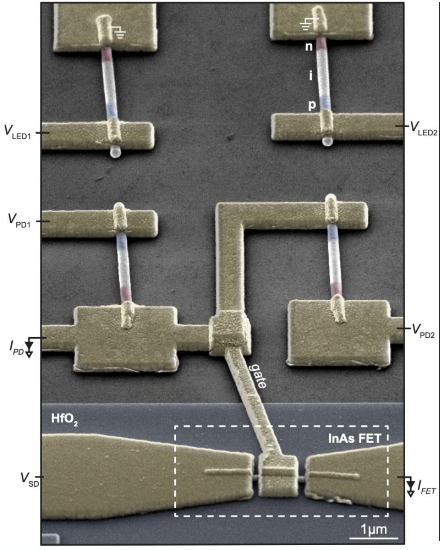
A nanoscale optoelectronic neuron combines InP nanowire light emitters and photodetectors with an InAs nanowire field-effect transistor. View full size ↗
Micrograph courtesy of Anders Mikkelsen and colleagues. Related publication: Sestoft et al., Nature Communications 17, 4798 (2026).
02 / From signals to observables
Particle detectors produce short, structured bursts of light. PHINDER will explore how spiking neural networks can encode their timing, estimate deposited energy and interaction position, and retain information about the spatial development of an event.
Neuromorphic Readout for Hadron Calorimeters demonstrates this approach in simulation and discusses a possible nanowire implementation. PHINDER’s planned demonstrator brings sensor-facing nanowire nodes, optical interconnects and neuromorphic processing together in a compact readout concept.
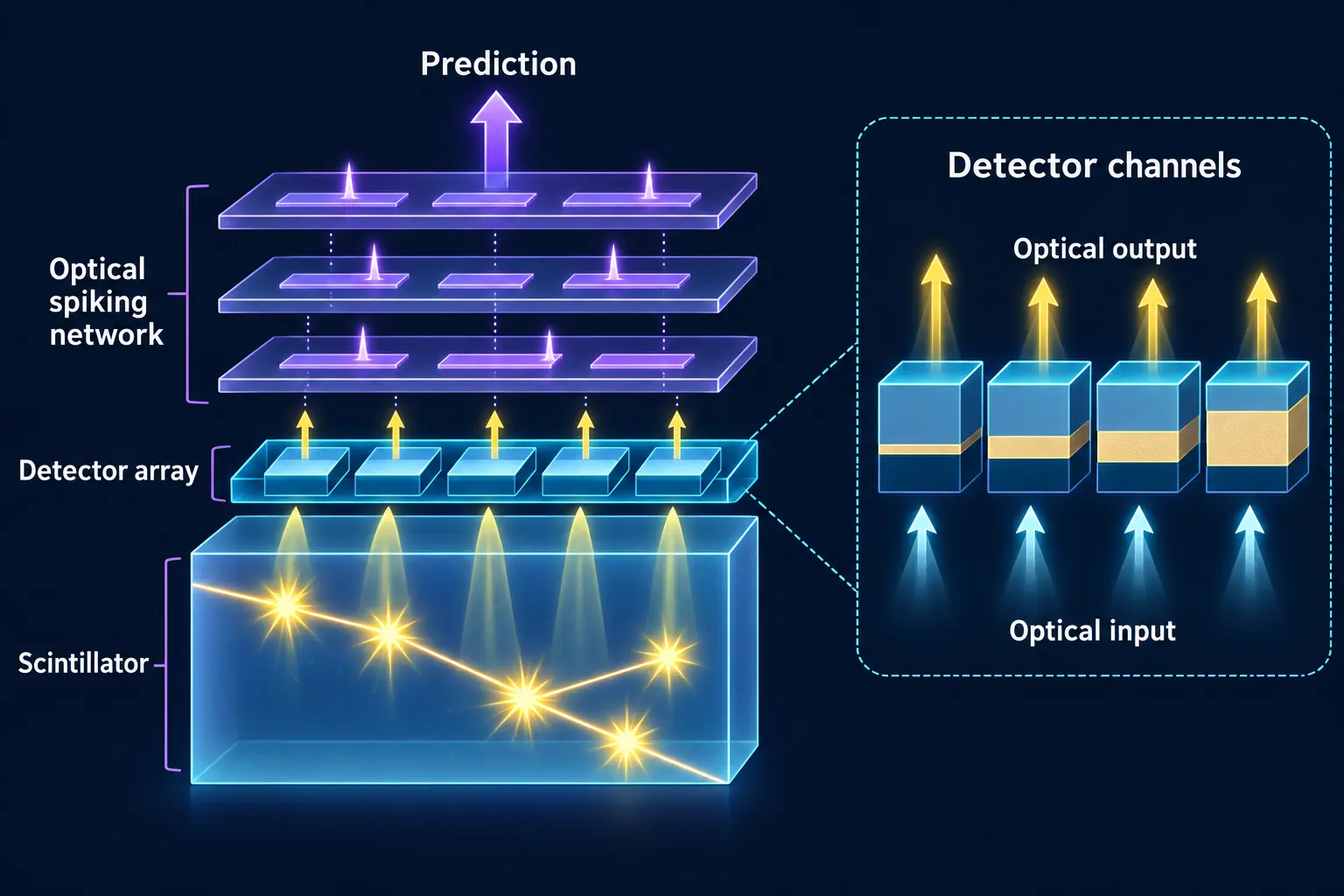
A proposed calorimeter readout converts scintillation light into signals for a layered optical spiking network. This is an explanatory concept, not a photograph of a completed PHINDER detector. View full size ↗
Simplified AI-assisted redraw of Figure 12 from Lupi et al., Particles (2025). · CC BY 4.0 · Original figure
03 / Applications
These are application directions for the platform under development. The published component and simulation results support the research programme; the integrated PHINDER system remains a project objective.
04 / A shared design problem
A useful sensor is defined by the information it can extract. Device physics, optical connectivity and learning algorithms therefore need to be developed together. Digital twins and learned surrogate models help connect component behaviour to application-level performance and guide the next prototype.
An experimentally demonstrated nanowire neuron combines excitatory and inhibitory optical inputs, signal integration and a nonlinear response.
Read publication →A fabricated emitter–receiver pair demonstrates direct optical communication between individual nanowire devices on a chip.
Read publication →Simulations connect time-structured scintillation light with spiking-network estimates of energy, position and shower shape.
Read publication →A wavelength-multiplexed InP architecture shows how weighted optical connections and nonlinear elements can form multiple neural-network layers.
Read publication →The AIDO framework uses a learned surrogate of simulation and reconstruction for gradient-based exploration of detector designs.
Read publication →A spiking neural network learns to identify charged-particle trajectories amid noise, supporting event-driven detector processing.
Read publication →